Reduction of PAPR using Huffrith Algorithm with Different Digital Modulation in NOMA System
Keywords:
Huffrith algorithm, Non-Orthogonal Multiple Access (NOMA), Quadrature Amplitude Modulation (QAM), Amplitude Phase Shift Keying (APSK), Peak-to-peak Average Ratio (PAPR)Abstract
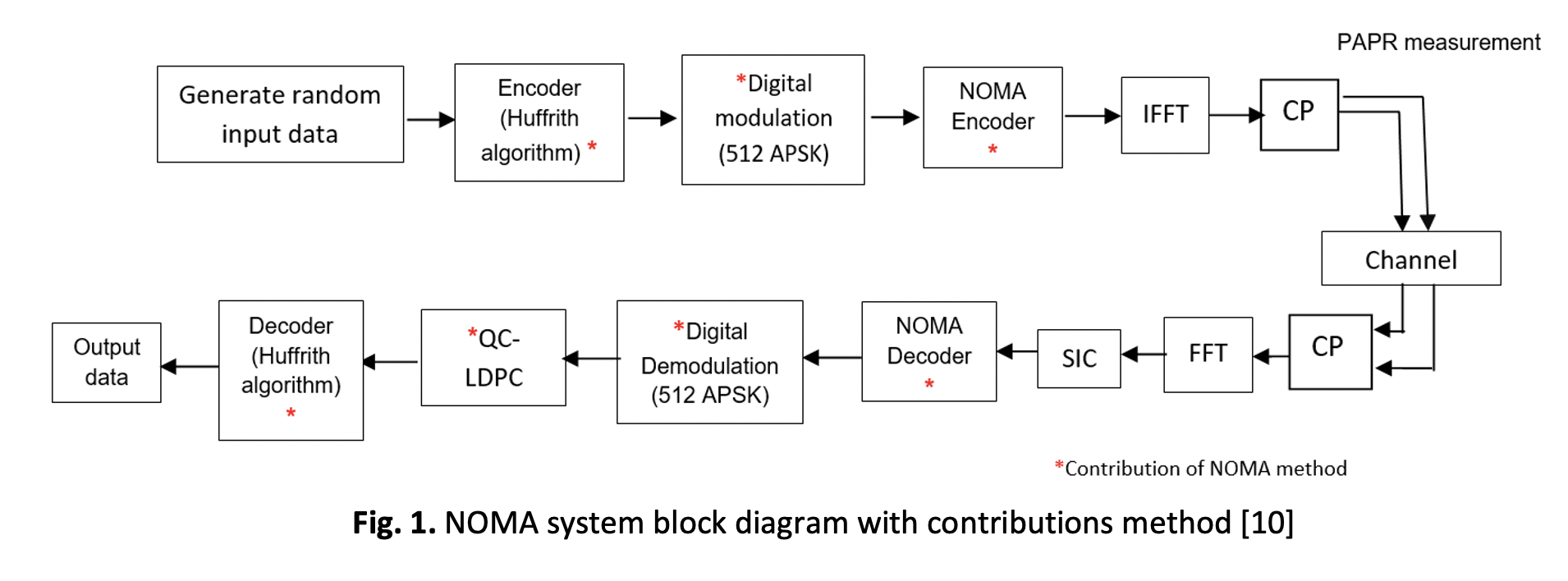
More efficient radio access approaches are needed for a full-scale deployment of sixth generation (6G) wireless systems because of the huge interconnectedness and rising needs of different services and data-hungry applications. Regarding this, academics and industry have recently been paying more and more attention to non-orthogonal multiple access, or NOMA. Because NOMA has a higher spectrum efficiency than orthogonal multiple access (OMA) approaches, it is suitable for 6G and beyond. Since OMA plan is unable to adequately enable huge connectivity such as IoT, NOMA has been regarded as a vital scheme. In this paper, QAM and APSK digital modulation techniques have been examined, utilizing 256 and 512 orders, respectively. As a result, APSK improves power efficiency rather than negatively impacting it. Huffrith is a new formulation of algorithm approach that can reduce PAPR more effectively than the conventional scheme. Simulation results show that the NOMA system with the 512-APSK modulation scheme achieves a 9.45 dB PAPR reduction and a 3.57% improvement over the OMA system.Downloads
Download data is not yet available.
Downloads
Published
2026-06-18
How to Cite
Nur Asfarina Idrus. (2026). Reduction of PAPR using Huffrith Algorithm with Different Digital Modulation in NOMA System . Journal of Advanced Research Design, 141(1), 320–328. Retrieved from https://www.akademiabaru.com/submit/index.php/ard/article/view/6836
Issue
Section
Articles